


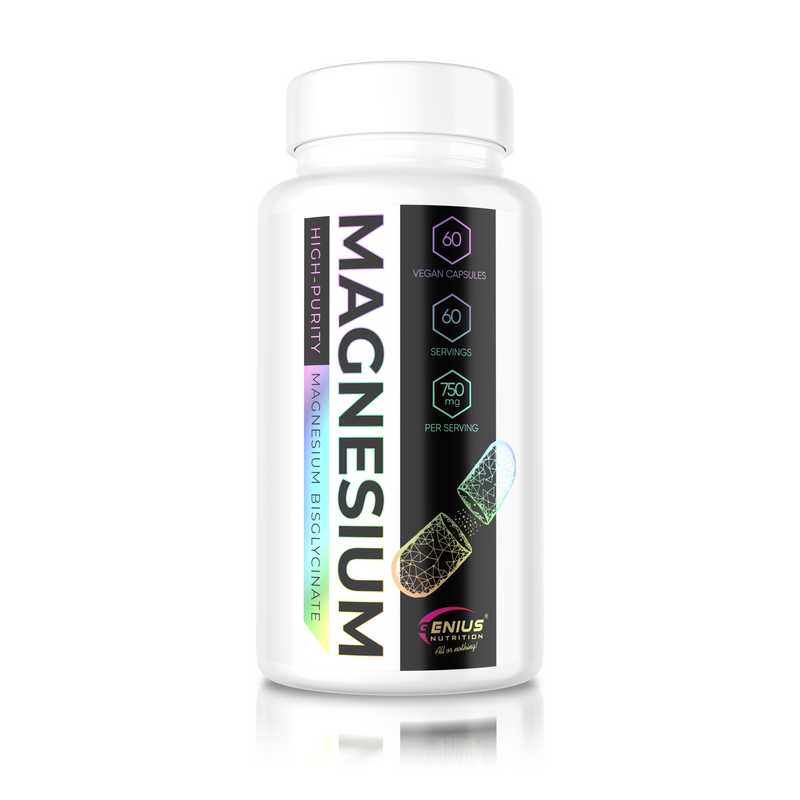
MAGNESIUM BISGLYCINATE
The form of magnesium your stomach tolerates. And your brain actually feels.
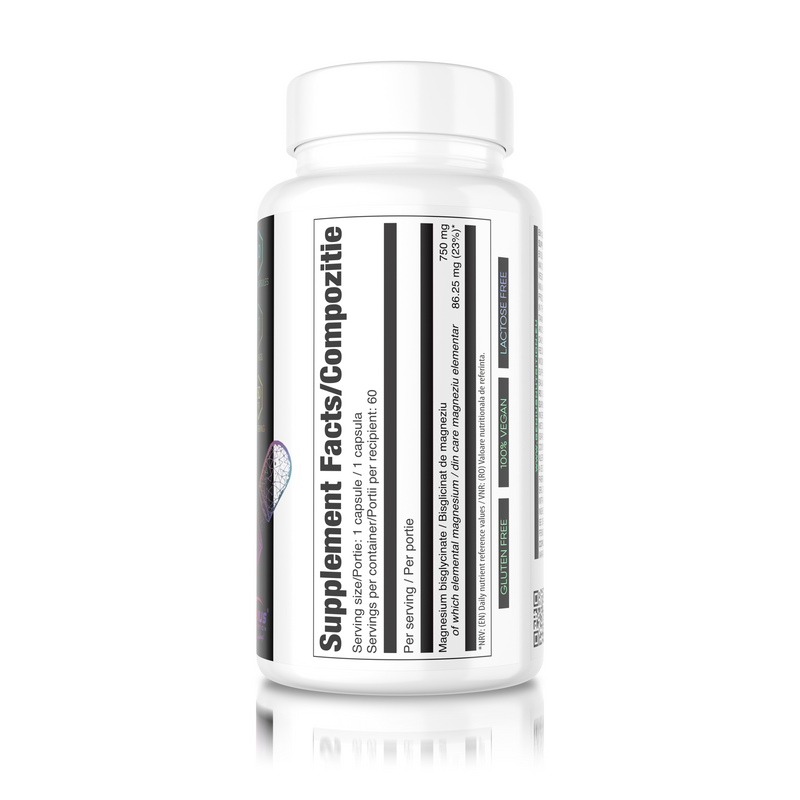
750mg magnesium bisglycinate per capsule, delivering 86.25mg elemental magnesium (23% NRV). Chelated form with two glycine molecules, superior bioavailability over inorganic forms, no laxative effect at normal dose. 60 vegan capsules.
*NRV: Nutrient Reference Values according to (EU) No. 1169/2011. See product label for full information.

It's not the magnesium that matters. It's the form you take it in.
Magnesium oxide, the cheapest form found in multivitamins, has a bioavailability of approximately 4%. Most of it is eliminated before being absorbed, with a frequent laxative effect at higher doses. Magnesium citrate is better, but can still cause digestive discomfort in some people.
Magnesium bisglycinate is a chelated form, in which magnesium is bound to two glycine molecules, an amino acid. This bond protects the mineral in the digestive tract, facilitates absorption through amino acid transporters, and minimizes irritation of the intestinal mucosa. The result: more magnesium effectively reaches the cells, without digestive side effects.
750mg bisglycinate = 86.25mg elemental Mg (11.5% elemental content)
Magnesium bisglycinate has an elemental content of approximately 11.5%, lower than oxide (60%) or citrate (16%). But what matters is not how much magnesium the compound contains, but how much magnesium reaches circulation. The superior bioavailability of bisglycinate compensates for the lower elemental content, delivering a useful and well-tolerated dose per capsule.
Glycine, the amino acid in the chelate, also brings its own benefit: it is a precursor of creatine, participates in collagen synthesis, and has documented calming effects at the neurological level.
Over 300 enzymatic reactions. One single mineral.
Magnesium is a cofactor for more than 300 enzymes and is involved in almost every major metabolic process in the body.
Nervous system and sleep
Magnesium regulates the activity of NMDA and GABA receptors, the main neurotransmitters of the central nervous system. Adequate levels support mental calm, anxiety reduction and sleep quality, especially during the falling-asleep phase and deep sleep.
Muscle function and cramps
Magnesium is the antagonist of calcium in muscle contraction. Calcium triggers contraction, magnesium relaxes it. Magnesium deficiency frequently manifests as nocturnal cramps, muscle spasms, fasciculations and slow post-exercise recovery.
Energy metabolism
ATP, the cell's energy molecule, is biologically active only in its magnesium-bound form (Mg-ATP). Without sufficient magnesium, cellular energy production is compromised, leading to chronic fatigue, lack of concentration and reduced performance under exertion.
EFSA-confirmed benefits and specific advantages of the bisglycinate form.
EFSA-approved claims for magnesium
- Reduction of tiredness and fatigue
- Normal functioning of the nervous system
- Normal muscle function
- Maintenance of normal bones
- Maintenance of normal teeth
- Normal protein synthesis
- Normal energy metabolism
- Normal electrolyte balance
EFSA-approved claims under Reg. (EC) No. 1924/2006.
Specific advantages of the bisglycinate form
- Superior bioavailability over oxide and carbonate forms
- Excellent gastric tolerability, no laxative effect at normal dose
- Absorption through amino acid transporters, independent of gastric acidity
- Glycine from the chelate supports sleep and mental calm
- Glycine is a precursor of creatine and collagen
- Suitable for people with digestive sensitivity
Magnesium deficiency is more widespread than you think.
People with cramps and muscle tension
Nocturnal cramps, muscle spasms and chronic tension are among the most frequent signs of a suboptimal magnesium level. Bisglycinate, taken in the evening, directly addresses this mechanism.
People with stress, anxiety and poor sleep
Magnesium regulates the stress response by modulating the HPA axis and GABA activity. Bisglycinate is the preferred form for neurological support due to the glycine in the chelate, which itself has documented calming effects.
Athletes and active individuals
Sweating eliminates magnesium in significant amounts. Deficiency reduces muscle performance, increases the risk of cramps, and slows recovery. Bisglycinate is the optimal form for athletes with digestive sensitivity.
Bisglycinate versus other forms of magnesium
The market is full of products with magnesium oxide or carbonate, marketed as if they were equivalent. They are not.
GENIUS NUTRITION® Magnesium Bisglycinate
Optimal form- Glycine-chelated form, superior bioavailability
- Absorption through amino acid transporters, high efficiency
- Excellent gastric tolerability, no laxative effect at normal dose
- Glycine from the chelate supports sleep, calm and collagen synthesis
- 750mg bisglycinate, delivering 86.25mg elemental Mg per capsule
- Vegan HPMC capsule, gluten free, lactose free
Magnesium oxide or carbonate (standard form)
Inferior form- Bioavailability of 4 to 10% of the administered dose
- Absorption dependent on gastric acidity, variable
- Frequent laxative effect at higher doses
- No benefits from the chelated amino acid
- Frequently found in cheap multivitamins as a filler ingredient
- Most of it eliminated before absorption
What the scientific literature says about magnesium bisglycinate
The form of magnesium matters. Comparative studies confirm significant differences between forms in terms of bioavailability, tolerability and functional effects.
Studies and documented mechanisms
How to use Magnesium Bisglycinate
The recommended daily dose is 1 capsule, taken with a large glass of water. For maximum effect on sleep, muscle relaxation and mental calm, the optimal timing is in the evening, 30 to 60 minutes before bedtime.
Daily dose: 1 capsule
How to take: with a large glass of water
Optimal timing: in the evening, 30 to 60 minutes before bedtime
Duration: 60 servings per container, 2 months of continuous support
When it is recommended
- In the evening, for sleep support, muscle relaxation and mental calm
- After intense training, for muscle recovery and replenishment of reserves
- During periods of high stress, when magnesium requirements increase
- For people with frequent nocturnal cramps or chronic muscle tension
- As daily support for energy metabolism and normal functioning of the nervous system
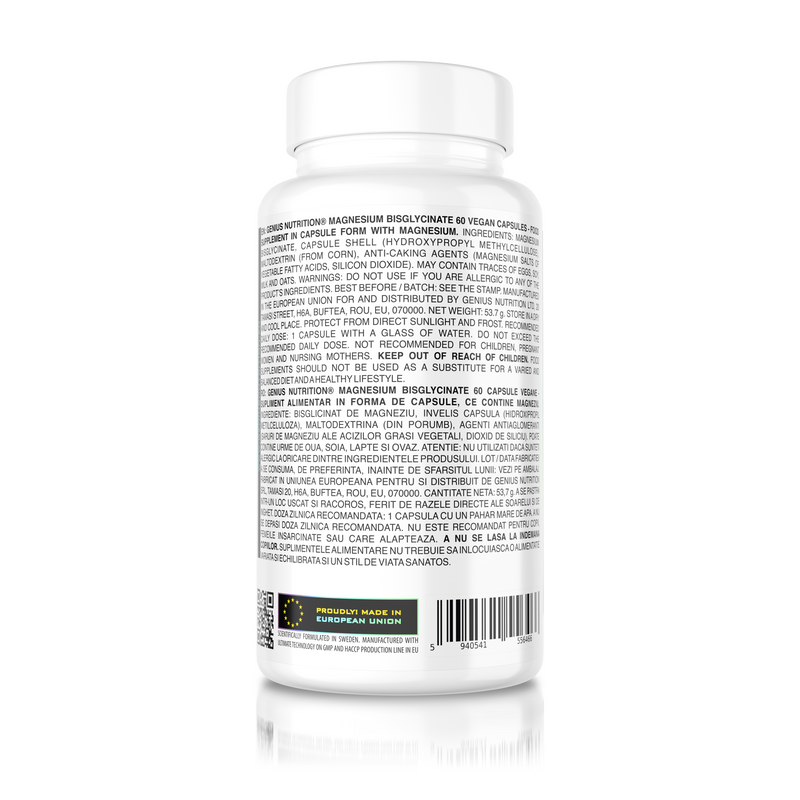
Do not exceed the recommended daily dose. Not recommended for children, pregnant or breastfeeding women. Keep out of reach of children. Food supplements should not replace a varied and balanced diet and a healthy lifestyle.
Frequently asked questions about GENIUS NUTRITION® Magnesium Bisglycinate
What is magnesium bisglycinate and how does it differ from other forms?
Why should I take magnesium in the evening?
Does it have a laxative effect?
Can I combine it with other supplements?
How quickly are effects felt?
Is it suitable for vegans?
Is 23% NRV enough or do I need a higher dose?
Scientific references
- Schuette SA et al. (2003). Bioavailability of magnesium diglycinate vs magnesium oxide in patients with ileal resection. Journal of the American College of Nutrition. PMID 12635112
- Abbasi B et al. (2012). The effect of magnesium supplementation on primary insomnia in elderly: A double-blind placebo-controlled clinical trial. Journal of Research in Medical Sciences. PMID 23853635
- Inagawa K et al. (2006). Subjective effects of glycine ingestion before the sleep period on sleep quality. Sleep and Biological Rhythms. PMID 16930802
- de Baaij JHF et al. (2015). Magnesium in man: implications for health and disease. Physiological Reviews. PMID 25540137
- Rosanoff A et al. (2012). Suboptimal magnesium status in the United States: are the health consequences underestimated? Nutrition Reviews. PMID 22364157
- Guerrera MP et al. (2009). Therapeutic uses of magnesium. American Family Physician. PMID 19621856
Magnesium Bisglycinate
the form your body absorbs. Not eliminates.
750mg magnesium bisglycinate. 86.25mg elemental Mg (23% NRV). Glycine-chelated form. Vegan HPMC capsule. 60 days of support for the nervous system, muscle function and energy metabolism.
MAGNESIUM BISGLYCINATE
The form of magnesium your stomach tolerates. And your brain actually feels.
750mg magnesium bisglycinate per capsule, delivering 86.25mg elemental magnesium (23% NRV). Chelated form with two glycine molecules, superior bioavailability over inorganic forms, no laxative effect at normal dose. 60 vegan capsules.
*NRV: Nutrient Reference Values according to (EU) No. 1169/2011. See product label for full information.
It's not the magnesium that matters. It's the form you take it in.
Magnesium oxide, the cheapest form found in multivitamins, has a bioavailability of approximately 4%. Most of it is eliminated before being absorbed, with a frequent laxative effect at higher doses. Magnesium citrate is better, but can still cause digestive discomfort in some people.
Magnesium bisglycinate is a chelated form, in which magnesium is bound to two glycine molecules, an amino acid. This bond protects the mineral in the digestive tract, facilitates absorption through amino acid transporters, and minimizes irritation of the intestinal mucosa. The result: more magnesium effectively reaches the cells, without digestive side effects.
750mg bisglycinate = 86.25mg elemental Mg (11.5% elemental content)
Magnesium bisglycinate has an elemental content of approximately 11.5%, lower than oxide (60%) or citrate (16%). But what matters is not how much magnesium the compound contains, but how much magnesium reaches circulation. The superior bioavailability of bisglycinate compensates for the lower elemental content, delivering a useful and well-tolerated dose per capsule.
Glycine, the amino acid in the chelate, also brings its own benefit: it is a precursor of creatine, participates in collagen synthesis, and has documented calming effects at the neurological level.
Over 300 enzymatic reactions. One single mineral.
Magnesium is a cofactor for more than 300 enzymes and is involved in almost every major metabolic process in the body.
Nervous system and sleep
Magnesium regulates the activity of NMDA and GABA receptors, the main neurotransmitters of the central nervous system. Adequate levels support mental calm, anxiety reduction and sleep quality, especially during the falling-asleep phase and deep sleep.
Muscle function and cramps
Magnesium is the antagonist of calcium in muscle contraction. Calcium triggers contraction, magnesium relaxes it. Magnesium deficiency frequently manifests as nocturnal cramps, muscle spasms, fasciculations and slow post-exercise recovery.
Energy metabolism
ATP, the cell's energy molecule, is biologically active only in its magnesium-bound form (Mg-ATP). Without sufficient magnesium, cellular energy production is compromised, leading to chronic fatigue, lack of concentration and reduced performance under exertion.
EFSA-confirmed benefits and specific advantages of the bisglycinate form.
EFSA-approved claims for magnesium
- Reduction of tiredness and fatigue
- Normal functioning of the nervous system
- Normal muscle function
- Maintenance of normal bones
- Maintenance of normal teeth
- Normal protein synthesis
- Normal energy metabolism
- Normal electrolyte balance
EFSA-approved claims under Reg. (EC) No. 1924/2006.
Specific advantages of the bisglycinate form
- Superior bioavailability over oxide and carbonate forms
- Excellent gastric tolerability, no laxative effect at normal dose
- Absorption through amino acid transporters, independent of gastric acidity
- Glycine from the chelate supports sleep and mental calm
- Glycine is a precursor of creatine and collagen
- Suitable for people with digestive sensitivity
Magnesium deficiency is more widespread than you think.
People with cramps and muscle tension
Nocturnal cramps, muscle spasms and chronic tension are among the most frequent signs of a suboptimal magnesium level. Bisglycinate, taken in the evening, directly addresses this mechanism.
People with stress, anxiety and poor sleep
Magnesium regulates the stress response by modulating the HPA axis and GABA activity. Bisglycinate is the preferred form for neurological support due to the glycine in the chelate, which itself has documented calming effects.
Athletes and active individuals
Sweating eliminates magnesium in significant amounts. Deficiency reduces muscle performance, increases the risk of cramps, and slows recovery. Bisglycinate is the optimal form for athletes with digestive sensitivity.
Bisglycinate versus other forms of magnesium
The market is full of products with magnesium oxide or carbonate, marketed as if they were equivalent. They are not.
GENIUS NUTRITION® Magnesium Bisglycinate
Optimal form- Glycine-chelated form, superior bioavailability
- Absorption through amino acid transporters, high efficiency
- Excellent gastric tolerability, no laxative effect at normal dose
- Glycine from the chelate supports sleep, calm and collagen synthesis
- 750mg bisglycinate, delivering 86.25mg elemental Mg per capsule
- Vegan HPMC capsule, gluten free, lactose free
Magnesium oxide or carbonate (standard form)
Inferior form- Bioavailability of 4 to 10% of the administered dose
- Absorption dependent on gastric acidity, variable
- Frequent laxative effect at higher doses
- No benefits from the chelated amino acid
- Frequently found in cheap multivitamins as a filler ingredient
- Most of it eliminated before absorption
What the scientific literature says about magnesium bisglycinate
The form of magnesium matters. Comparative studies confirm significant differences between forms in terms of bioavailability, tolerability and functional effects.
Studies and documented mechanisms
How to use Magnesium Bisglycinate
The recommended daily dose is 1 capsule, taken with a large glass of water. For maximum effect on sleep, muscle relaxation and mental calm, the optimal timing is in the evening, 30 to 60 minutes before bedtime.
Daily dose: 1 capsule
How to take: with a large glass of water
Optimal timing: in the evening, 30 to 60 minutes before bedtime
Duration: 60 servings per container, 2 months of continuous support
When it is recommended
- In the evening, for sleep support, muscle relaxation and mental calm
- After intense training, for muscle recovery and replenishment of reserves
- During periods of high stress, when magnesium requirements increase
- For people with frequent nocturnal cramps or chronic muscle tension
- As daily support for energy metabolism and normal functioning of the nervous system
Do not exceed the recommended daily dose. Not recommended for children, pregnant or breastfeeding women. Keep out of reach of children. Food supplements should not replace a varied and balanced diet and a healthy lifestyle.
Frequently asked questions about GENIUS NUTRITION® Magnesium Bisglycinate
What is magnesium bisglycinate and how does it differ from other forms?
Why should I take magnesium in the evening?
Does it have a laxative effect?
Can I combine it with other supplements?
How quickly are effects felt?
Is it suitable for vegans?
Is 23% NRV enough or do I need a higher dose?
Scientific references
- Schuette SA et al. (2003). Bioavailability of magnesium diglycinate vs magnesium oxide in patients with ileal resection. Journal of the American College of Nutrition. PMID 12635112
- Abbasi B et al. (2012). The effect of magnesium supplementation on primary insomnia in elderly: A double-blind placebo-controlled clinical trial. Journal of Research in Medical Sciences. PMID 23853635
- Inagawa K et al. (2006). Subjective effects of glycine ingestion before the sleep period on sleep quality. Sleep and Biological Rhythms. PMID 16930802
- de Baaij JHF et al. (2015). Magnesium in man: implications for health and disease. Physiological Reviews. PMID 25540137
- Rosanoff A et al. (2012). Suboptimal magnesium status in the United States: are the health consequences underestimated? Nutrition Reviews. PMID 22364157
- Guerrera MP et al. (2009). Therapeutic uses of magnesium. American Family Physician. PMID 19621856
Magnesium Bisglycinate
the form your body absorbs. Not eliminates.
750mg magnesium bisglycinate. 86.25mg elemental Mg (23% NRV). Glycine-chelated form. Vegan HPMC capsule. 60 days of support for the nervous system, muscle function and energy metabolism.